
A Buyer's Checklist for a Large-Volume Scent Range
A large-volume scent range is bought on programme decisions, not on unit price. The volume per SKU, the pack format, the destination markets and the service scope all come before any quotation, because each one moves the cost more than the fragrance oil itself. A buyer who locks those four early gets numbers that can be compared; a buyer who skips them gets a spreadsheet of apples and oranges. Work through this checklist before the first request for quotation, and most of the expensive surprises disappear.
Key takeaways
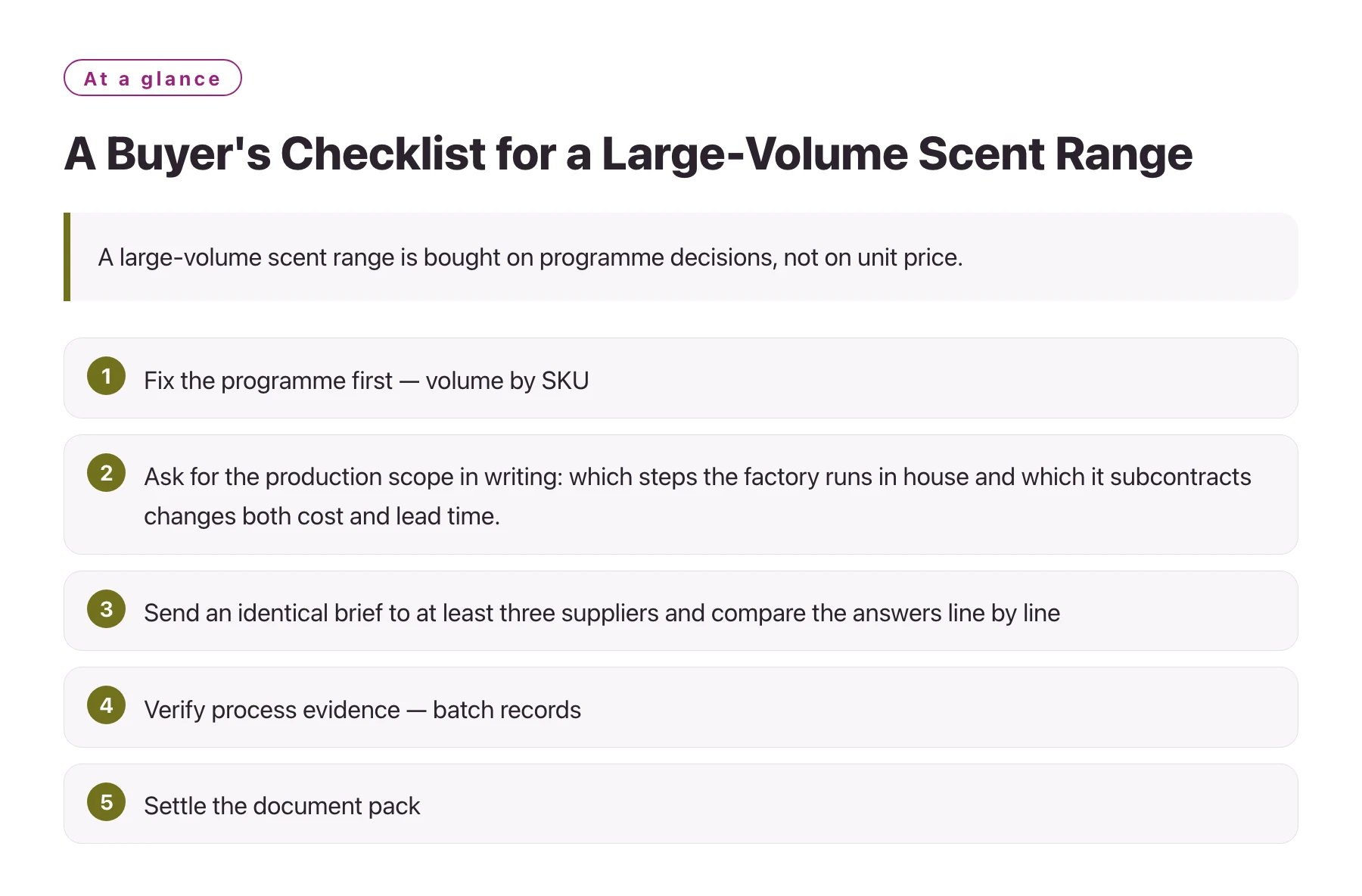
- Fix the programme first — volume by SKU, pack format, destinations and service scope — because every later number depends on those four.
- Ask for the production scope in writing: which steps the factory runs in house and which it subcontracts changes both cost and lead time.
- Send an identical brief to at least three suppliers and compare the answers line by line, not column by column of totals.
- Verify process evidence — batch records, retained samples and an auditable GMP framework — rather than accepting a list of certificates.
- Settle the document pack, the sample approval reference and the ownership of the formula and mould before the deposit.
The usual way to start this conversation is with a request for the unit price. That is the least useful first question for a large order, because the answer depends on decisions that have not been made yet: how many units per SKU, which bottle, which markets, and what exactly the manufacturer is expected to do.
This piece is the order to work through instead. It is written for a procurement or product lead buying fragrance at volume — tens of thousands of units per SKU — who wants the process to be repeatable rather than a one-off gamble.
Start with the programme, not the price
A large programme is a small number of big decisions. The first is volume per SKU, because development, tooling and testing costs spread very differently at five thousand units than at fifty thousand. The second is the pack format: bottle, pump, crimp, decoration and carton often outweigh the concentrate in unit cost, and every change in the format rewrites the quote.
The third is the destination markets, because they determine the documentation, the label data and the testing. The fourth is the service scope — whether the manufacturer develops the scent, designs the pack, fills and assembles, or only compounds. None of these can be inferred from a price list.
Volume by SKU changes everything
A range with five SKUs sharing one concentrate is a different project from five SKUs with five formulas. Tooling, artwork and stability testing are largely one-time costs, so the buyer who fixes the SKU structure early knows which line items are fixed and which are marginal.
The pack format moves the unit price more than the juice does
Fragrance concentrate is only a fraction of the finished unit. The bottle, closure, decoration and carton carry most of both the cost and the lead time, and they are the part of the quotation that keeps moving while the product is still being designed. Lock the format before the quote, or every quote is a moving target.
Define the service scope or pay for it twice
Some buyers want compounding only; others want the whole chain from a scent idea to a filled, decorated bottle. A factory organised as fragrance manufacturing under one roof can price that chain in a single list, which makes the comparison against a partial supplier much easier. If the scope is left vague, work falls into the gaps between stages and comes back as extras.
The pre-quote checklist, phase by phase
| Phase | What to fix | What it protects |
|---|---|---|
| Programme | SKU list, volumes per SKU, pack formats, destinations | Comparable quotations |
| Scope | In-house steps versus subcontracting, per stage | Cost and lead time |
| Compliance | Documentation and testing required per market | Market access |
| Samples | Approval reference, retained sample, batch number | Repeatability |
| Contract | Formula and mould ownership, intangibles, exit terms | Your assets |
| First order | Pass criteria and a review date | Confidence to scale |
Read the last row first. The first order is the only test that matters; everything before it is prediction.
What the quotation must lay open
A useful quotation for a large programme is broken into lines: concentrate, bottle, closure, decoration, filling, testing, packaging and freight. A single lump number tells you nothing about where the cost sits or where a competitor could legitimately come in lower.
The comparison also works in reverse. When every candidate quotes the same nine lines, differences in price become visible as differences in what each factory controls — and a manufacturer that states its scope publicly, as a house like the Xuelei brand does, makes this check an afternoon's work rather than a week of follow-up calls.
The difference between a certificate and a process
Certificates show that a management system was audited at some point. Batch records show what actually happened on a specific run. A cosmetics GMP framework such as ISO 22716 exists precisely to make that traceability routine [1], and a factory that works to it will have the records ready to walk through before the order is signed.
Check the market file, not the marketing
Every destination market has its own obligations; the EU, for example, applies a harmonised rulebook to cosmetic products placed on its market, and the buyer remains accountable for the final label [2]. Ask what each candidate keeps on file for the markets you ship to, and treat the file as a capability indicator rather than a promise of compliance.
Give the factory a past you can check
For a range that will reorder for several seasons, the buyer should be able to look behind the quotation. Long export experience tends to show in the details: the certificates held, the markets filed for, the steps run in house. That record is exactly the information behind the company behind the factory, and it turns a one-off transaction into a sourcing relationship that survives the first season.
One page, signed by both sides. The model, the scope, the SKU structure, the ownership of the formula and mould, the approval reference and the document list all fit on one page. Everything else in a large programme can move; those six points should not.
Sources
- SGS: Cosmetics, Personal Care & Household Testing —— Testing, inspection and certification services for cosmetics and personal care, including microbiological, stability and safety testing aligned with cosmetics GMP.
- European Commission: Cosmetics in the EU —— The European Commission's overview of EU cosmetics rules, including the responsible person, product information file and safety report requirements.
Frequently asked questions
How many suppliers should I approach for a large fragrance programme?
Three, working from an identical written brief. Fewer gives you nothing to compare; more dilutes the time you have for reading the answers line by line rather than on totals.
What makes one quotation higher than another on the same brief?
Usually the scope, not the pricing: in-house versus subcontracted steps, the testing included, the pack components and the destination documentation. That is why asking every candidate to quote the same nine lines matters more than the final total.
When should I start the compliance work?
At the brief stage. The destination markets decide the document list, the label data and the testing, and rebuilding a label for a second market after the first order is one of the most avoidable costs in the programme.
Do I need a factory audit before a large first order?
A full audit is ideal, but a batch record walk-through plus a retained sample review covers most of the real risk. Certificates alone are not evidence of how a specific run was made.
What should the first order prove?
That the factory can repeat the approved sample at the quoted price and lead time and deliver the document pack. If those three fail on a small run, a larger run will not fix them.